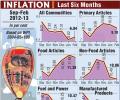
The wholesale price index, the main inflation indicator, rose an annual 6.84 per cent in February, higher than the 6.54 per cent rise estimated by analysts.

In December, the index fell a provisional 0.73 per cent.

In most parts of the landlocked northeastern state, items such as rice, potato, onion and egg besides LPG cylinders and petrol are selling at rates much above the ones fixed by the government.

Passenger vehicle wholesales in India witnessed a marginal growth in May on account of high base effect and muted demand due to general elections. The overall passenger vehicle dispatches from companies to dealers stood at 350,257 lakh units last month as compared to 335,436 in the same month a year ago, registering a growth of 4 per cent.

The retail inflation rate breached the 6 per cent upper tolerance limit of the RBI for the first time in seven months in January, while the wholesale price index stayed in double-digits for the 10th month in a row, showed two sets of data released by the government on Monday. Retail inflation, the key input for the RBI while reviewing the repo rate every two months, soared during the month mainly because of a spike in certain food items. The previous high for retail inflation was 6.26 per cent in June 2021.

India's annual rate of inflation, based on its monthly Wholesale Price Index, climbed to 6.01 per cent for the month of May 2014, as against 5.20 per cent for May and 4.58 per cent during the corresponding month of the previous year, which has set off alarm bells.

The Freedom 125 has sold 8,310 units in October to date. This is its highest since it was launched in July and may touch close to 9,000 by the end of the month.

As milk prices rise, analysts have an optimistic view on dairy stocks such as Heritage Foods and Dodla Dairy, hoping the companies' margins will grow in the near to medium term. From a long-term perspective, they believe that a growing population, increasing disposable income and health consciousness will strengthen dairy consumption in India.

WPI at 3-month high; surge in all broad categories; CPI at 2-month high.
With fuel being the main input cost for the transport sector, rise in cost of operations is a given. The sector is unsure on the extent of being able to pass this on through rentals or to absorb it with higher volumes.
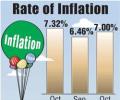
Food prices rose 18.19 per cent year-on-year in October, slower than an annual rise of 18.4 per cent in September.

Wholesale price-based inflation spiked to a record high of 15.08 per cent in April on rising prices across segments from food to commodities. The WPI-based inflation was 14.55 per cent in March and 10.74 per cent in April last year. "The high rate of inflation in April 2022 was primarily due to rise in prices of mineral oils, basic metals, crude petroleum & natural gas, food articles, non-food articles, food products and chemicals & chemical products etc. as compared to the corresponding month of the previous year," the commerce and industry ministry said in a statement.

Deflation masked the rise in food inflation to a 5-month high.

In Delhi, the wholesale price is now Rs 48-52 a kg; the retail one is Rs 80 a kg.

Benchmark 10-year bond yields hit a 13-month peak as bond traders priced in more aggressive monetary easing next year.
'If you see the composition of items which are causing this spike in prices, most of them have little to do with the kharif harvest, except for pulses and vegetables to some extent.' 'I don't know on what basis the government is claiming that food prices will moderate in the weeks to come.'

The wholesale price-based inflation in February rose to 13.11 per cent on hardening of prices of crude oil and non-food items, even though food articles softened. After two months of mild easing, WPI inflation accelerated in February and remained in double digits for the 11th consecutive month, beginning April 2021. WPI inflation last month was 12.96 per cent, while in February last year, it was 4.83 per cent. The rise in crude oil and natural gas prices after the Russian invasion of Ukraine, beginning February 24, has put pressure on the wholesale price index, even though food articles saw softening across categories of vegetables to pulses to protein-rich items.

Benchmark equity index Sensex and Nifty gave up early gains and ended lower on Monday as investor sentiment was hit due to unabated foreign fund outflows and losses in index heavyweights Reliance Industries and HDFC Bank. The 30-share BSE Sensex declined 168.21 points or 0.28 per cent to settle at 60,092.97 as 15 of its constituents dropped. The barometer opened higher and touched a high of 60,586.77 in morning session. Later in the day, it fell 297.35 points or 0.49 per cent to 59,963.83.

The US retail giant operates 20 wholesale stores under the brand 'Best Price' in India.

This increases expectations that RBI may cut rates later this month.
Pulses inflation remained stubborn at 35.56 per cent.

The RBI said recently that the upsurge in inflation in April was led by food and commodity prices.

'We are seeing one of the highest discounts in recent years across companies.' 'October is a crucial month with several festivals coming up.'

Benchmark indices Sensex and Nifty ended with gains on Wednesday, extending the previous day rally amid lower level of inflation on domestic front and better-than-expected inflation readings from the US. The 30-share BSE Sensex climbed 144.61 points or 0.23 per cent to settle at 62,677.91. During the day, it jumped 301.81 points or 0.48 per cent to 62,835.11.

Tomato prices in retail markets of metro cities have shot up to Rs 72 per kilogram on tight supply due to unseasonal rains in key producing states like Madhya Pradesh and Maharashtra.

'We are seeing signs of improvement in rural overall in terms of demand, but I would still keep my fingers crossed.'

Trading in the equity market this week will be highly influenced by a host of important triggers, with quarterly earnings from IT majors TCS, Wipro, and domestic inflation and IIP data taking the centre stage in dictating the movement in equities, analysts said. Besides, global factors and trading activity of foreign investors will also drive markets. "We are approaching the first quarter earnings season, with HCL Tech, TCS and Wipro set to report their earnings this week.
Inflation in food articles, fuel and power contracted in July.

The hardening of the Wholesale Price Index follows an uptick in retail inflation.
The country's largest private lender HDFC Bank on Saturday reported a 6.51 per cent decline in its consolidated net profit to Rs 16,474.85 crore in the April-June quarter compared to the previous January-March quarter. The city-headquartered lender, which merged its mortgage major parent HDFC into itself in July last year, had reported a net profit of Rs 17,622.38 crore in the March quarter. On a standalone basis, the net profit declined to Rs 16,174.75 crore in April-June 2024-25 from Rs 16,511.85 crore in January-March 2023-24.
In November, wholesale prices, India's main inflation measure, rose 7.52 percent, their fastest pace in 14 months.

The company has the largest car park in EVs in India, estimated to be around 170,000 units. As a pilot, it has already started work with used online car marketplace Spinny.
During the week, prices of fish marine were dearer by 10 per cent, arhar, fruit and vegetables by 2 per cent each while urad and moong rose by 1 per cent each.

From its recent lows, the stock of consumer major Marico is up 7 per cent on the back of a better-than-expected June quarter performance and robust outlook. In a pre-quarter update, the management indicated that domestic volume growth should witness an improvement in FY25, while other segments (growth portfolio, international business) too would see traction going ahead. The near-term trigger is strong sales and operating performance for Q1FY25.
Inflation based on the wholesale-price-index was unchanged at 3.5 per cent for the week ended December 29, 2007.

The median forecast for wholesale price index-based inflation in the first quarter of 2010/11 is at 10.4 per cent, according to Reserve Bank of India's survey, higher than 9.5 per cent in the previous survey.

Onions prices are still ruling at an unaffordable level, though rates have started softening both in the wholesale and retail markets across the country following government measures like allowing cooperative Nafed to import onions.
Inflation based on the wholesale price index moved up to 4.54 per cent for the week ended November 26 from 4.32 per cent in the previous week, according to data released by the government on Friday.

The Centre on Friday said it will sell 'Bharat Rice' in the retail market at Rs 29 per kg from next week to give relief to the common man and has also directed traders to disclose rice/paddy stock, as part of its efforts to control prices that have risen by around 15 per cent in the last one year. In a press conference, Union Food Secretary Sanjeev Chopra exuded confidence that these two measures along with the various restrictions of exports will help in cooling down the prices. Seeking to dispel market rumours, he categorically said the government has no plans to lift restrictions on rice exports any time soon.

Data on primary and fuel items would continue to be released on weekly basis.
 © 2026 Rediff.com - Advertise with us - Disclaimer - Privacy Policy - Sitemap - Feedback - About us - Terms of use - Grievances